Have you ever wondered how ChatGPT understands your questions, how Google Translate converts one language into another, or how virtual assistants like Siri and Alexa respond to spoken commands? Behind all these technologies lies a powerful branch of Artificial Intelligence known as Natural Language Processing, commonly referred to as NLP.
Natural Language Processing is the field of AI that focuses on helping computers understand, interpret, process, and generate human language. Human communication is naturally complex. We use different languages, slang, emotions, abbreviations, context, and cultural references. For computers, understanding these variations is far more challenging than processing numbers or structured data.
The goal of NLP is to bridge the communication gap between humans and machines. Instead of forcing people to learn programming languages or complicated commands, NLP enables computers to understand language in a way that feels natural and intuitive.
Modern NLP systems are capable of analyzing text, identifying meaning, recognizing intent, understanding sentiment, extracting information, translating languages, answering questions, and even generating new content. These capabilities have transformed how people interact with technology.
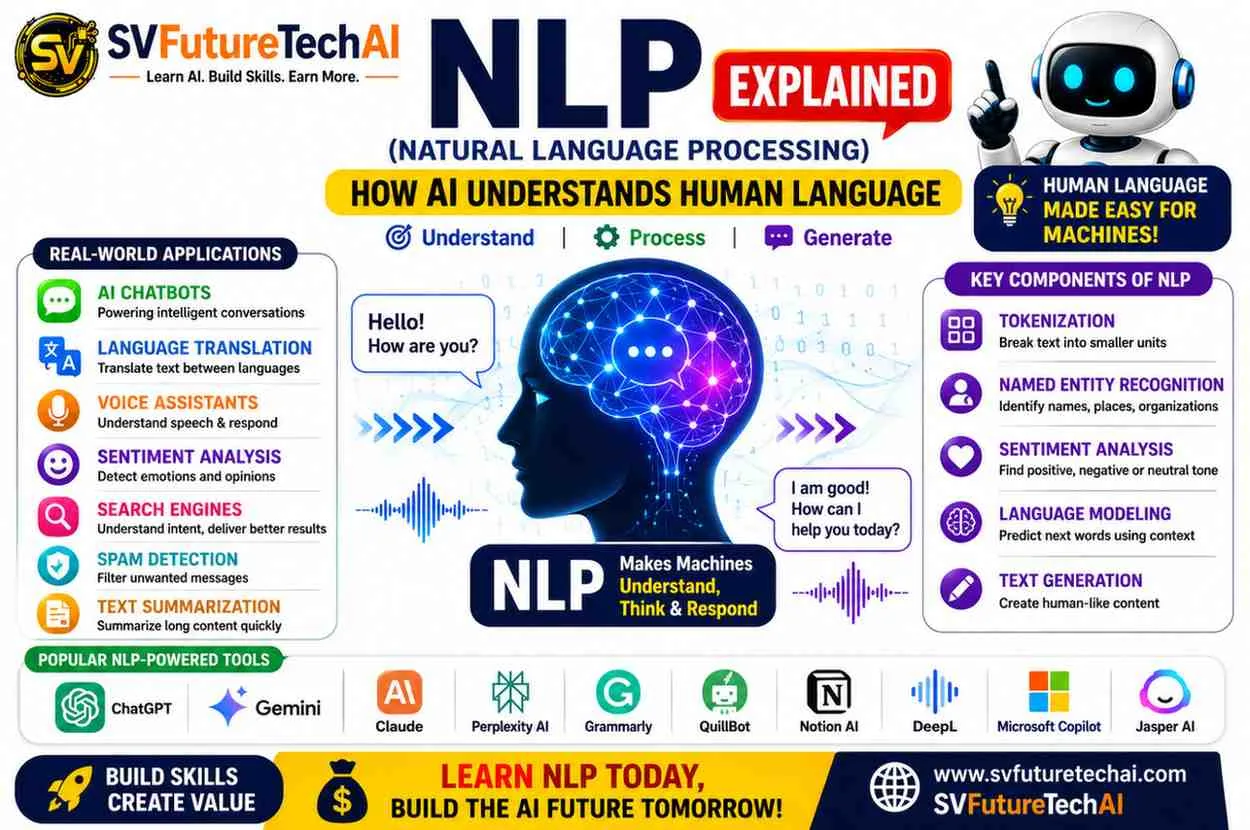
Popular Applications of NLP
AI Chatbots
- ChatGPT
- Gemini
- Claude
- Microsoft Copilot
These tools use NLP to understand user prompts and generate relevant responses.
Language Translation
NLP powers translation systems that convert text between multiple languages while preserving context and meaning.
Voice Assistants
- Siri
- Alexa
- Google Assistant
These assistants use NLP to understand spoken requests and provide useful responses.
Sentiment Analysis
Businesses use NLP to analyze customer reviews, social media comments, and feedback to understand public opinion.
Search Engines
Modern search platforms use NLP to better understand user intent rather than simply matching keywords.
Spam Detection
Email providers use NLP techniques to identify unwanted messages and protect users from spam.
Text Summarization
AI systems can automatically create shorter summaries of long documents, articles, and reports.
Key Components of NLP
Tokenization
Breaking text into smaller units such as words, phrases, or symbols.
Named Entity Recognition
Identifying names, locations, organizations, products, and important entities within text.
Sentiment Analysis
Determining whether content expresses positive, negative, or neutral emotions.
Language Modeling
Predicting the next word or phrase based on context.
Text Generation
Creating new human-like content using learned language patterns.
AI Tools That Use NLP
Popular NLP-Powered Platforms
- ChatGPT
- Gemini
- Claude
- Perplexity AI
- Grammarly
- QuillBot
- Notion AI
- Jasper AI
- Microsoft Copilot
- DeepL Translator
In recent years, NLP has advanced significantly because of Large Language Models (LLMs). These models are trained on massive amounts of text and can identify complex language patterns. As a result, modern AI systems can engage in conversations, answer questions, write articles, summarize information, generate code, and assist with countless daily tasks.
Despite its impressive capabilities, NLP still faces challenges. Human language contains ambiguity, sarcasm, regional expressions, emotions, and cultural nuances that can be difficult for machines to interpret correctly. Researchers continue to improve NLP systems to make interactions more accurate and natural.
As Artificial Intelligence continues to evolve, NLP will remain one of the most important technologies powering intelligent digital experiences. From education and healthcare to customer service and software development, NLP is transforming how humans communicate with machines.
Understanding NLP provides valuable insight into the technology behind modern AI applications and helps individuals appreciate how machines are becoming increasingly capable of understanding human communication.
SV Future Tech AI regularly publishes educational articles about Artificial Intelligence, Machine Learning, AI Tools, Automation, Programming, Emerging Technologies, and Digital Innovation. This article was created with the assistance of AI technology and carefully refined to ensure clarity, accuracy, and practical value. Our mission is to help students, professionals, freelancers, entrepreneurs, and technology enthusiasts learn future-ready skills and stay informed about the rapidly changing world of Artificial Intelligence.