Artificial intelligence is no longer something Indian businesses are simply testing on the side. AI is increasingly becoming part of everyday business operations, from automation and decision-making to productivity and customer-facing tools.
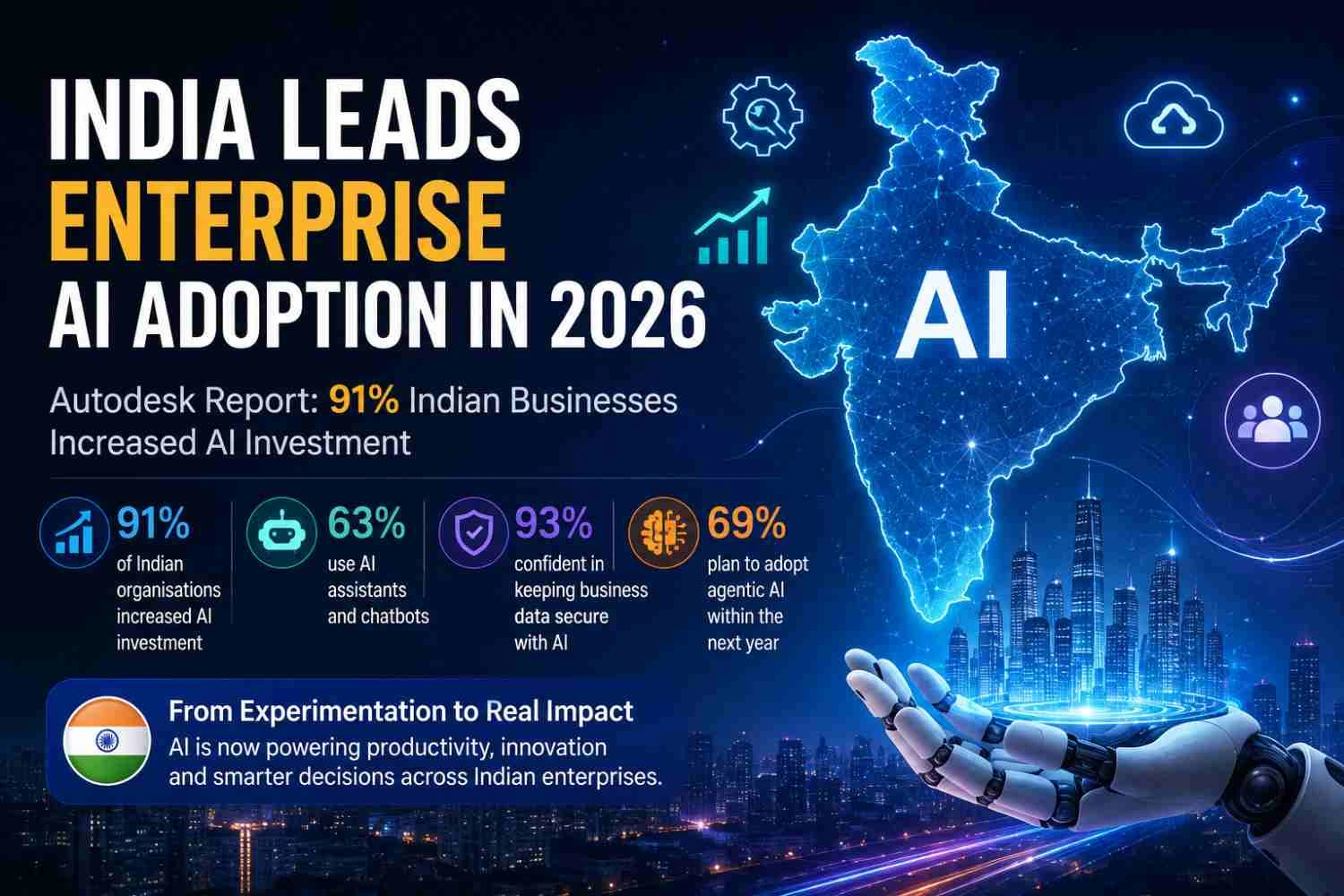
A new Autodesk 2026 AI Pulse Report shows just how quickly this shift is happening. According to the report, 91% of surveyed Indian organisations increased their AI investment over the past year, putting India ahead of the reported APAC average of 85% and global average of 81%.
The findings suggest that Indian businesses are moving beyond the early experimentation phase and are increasingly looking at AI as a long-term business capability.
Autodesk's broader 2026 AI Pulse research surveyed 2,500 leaders and experts across the Design and Make industries, including architecture, engineering, construction, manufacturing, design, media and entertainment.
AI Adoption Is Becoming the New Normal for Indian Businesses
One of the strongest signals from the India data is how widespread AI usage has become.
The report says 63% of surveyed Indian organisations are using AI assistants and chatbots, the highest adoption rate reported across the APAC markets covered in the survey. Importantly, none of the Indian organisations surveyed reported operating without AI tools.
For businesses, this represents a change in mindset.
Instead of asking whether AI should be introduced, companies are increasingly asking where it can deliver the most practical value.
That could mean automating repetitive processes, helping employees find information faster, improving business decisions or supporting creative and technical teams.
Indian Companies Are Seeing Real Business Benefits From AI
AI adoption would not continue at this pace if companies were not seeing useful results.
According to the report, nearly 88% of Indian respondents said AI has improved productivity, while 84% reported stronger innovation outcomes. Another 75% said AI is helping their organisations make better decisions.
This is an important development because enterprise AI is increasingly being judged by business outcomes rather than the number of tools a company has deployed.
For example, an AI system that saves employees several hours every week can have a much more meaningful impact than simply adding another chatbot to a company's website.
The next stage of enterprise AI is therefore likely to focus less on experimentation and more on measurable results.
Generative AI Remains the Top Investment Priority
Indian businesses are not investing equally across every area of AI.
Generative AI leads the investment priorities at 74%, followed by process automation at 58% and decision-support AI at 54%. AI agents are also becoming part of corporate investment plans, with 51% of organisations prioritising them.
This shows that companies are exploring AI across different layers of their operations.
Generative AI can help employees create and summarise information, develop ideas and work with large amounts of content.
Process automation can reduce manual tasks.
Decision-support systems can help employees analyse information and make more informed choices.
Together, these technologies are pushing AI deeper into everyday business workflows.
Agentic AI Could Be the Next Big Enterprise Shift
The next major change could come from agentic AI.
Unlike a conventional chatbot that mainly responds to individual prompts, AI agents are designed to handle multi-step tasks and work across workflows with greater autonomy.
The Autodesk report indicates that 69% of surveyed Indian organisations expect to adopt agentic AI within the next year.
That is a significant signal.
It suggests businesses are beginning to think beyond AI that simply answers questions and toward systems that can actually help execute work.
For example, an AI agent could potentially coordinate several steps in a workflow, gather information, analyse it and trigger follow-up actions based on predefined rules.
However, this transition also brings new questions around security, governance, accuracy and human oversight.
Indian Businesses Show Strong Confidence in AI Data Security
One area where India stands out in the report is confidence around data security.
93% of Indian respondents said they believe their organisation can keep business data secure while using AI, which the report identifies as the highest level recorded among the markets surveyed.
That confidence is important because data security remains one of the biggest concerns surrounding enterprise AI.
Businesses want the benefits of AI, but they also need to know what happens to sensitive company information when employees use AI systems.
As AI becomes embedded into business processes, security policies, access controls, data governance and employee training will become increasingly important.
AI Is Also Supporting Business Expansion
The report highlights another interesting trend: Indian companies appear increasingly confident about using AI while pursuing growth.
Around 87% of Indian respondents said their organisations are actively exploring new markets, making India the most expansion-focused market among those surveyed.
AI can potentially support this expansion by helping companies analyse markets, understand customer behaviour, automate operations and improve decision-making.
For companies operating across multiple regions, AI can also help teams process large amounts of information more efficiently.
India's AI Workforce Is Becoming Better Prepared
Technology adoption alone isn't enough.
Companies need employees who understand how to use AI effectively and responsibly.
According to the report, 70% of Indian respondents believe their organisations provide sufficient AI training. That compares with 57% across APAC and 59% globally.
Leadership support is also relatively strong.
About 88% of Indian respondents said senior leaders actively encourage AI adoption, compared with 81% across APAC.
This combination of investment, training and leadership support could help Indian businesses move faster from AI pilots to larger deployments.
But Enterprise AI Still Has Major Challenges
Despite the strong adoption numbers, Indian businesses are not ignoring the difficulties involved in scaling AI.
The report identifies several major implementation challenges:
- Regulatory uncertainty — 50%
- AI skills shortages — 49%
- System integration — 47%
- Data quality — 45%
These challenges highlight an important reality.
Buying an AI tool is relatively easy.
Integrating AI into an existing organisation is much harder.
A company may have excellent AI software, but if its internal data is poorly organised, systems don't communicate with each other or employees don't know how to use the technology, the expected benefits may not materialise.
India's Enterprise AI Journey Is Moving Into a New Phase
The numbers from Autodesk's report point toward a broader change in India's technology landscape.
AI investment is increasing, usage is spreading across organisations and businesses are beginning to connect AI adoption with productivity, innovation and decision-making.
The focus is also shifting toward more advanced technologies such as AI agents.
But the next stage will not simply be about who adopts AI first.
It will be about who integrates it properly.
Companies that connect AI with good-quality data, trained employees, secure systems and clearly defined business objectives are likely to get more value from their investments.
Autodesk's broader research similarly points to effective implementation across systems, processes and teams as the emerging source of competitive advantage, rather than simply having access to AI technology.
What This Means for Indian Businesses
For Indian companies, the report offers both an opportunity and a warning.
The opportunity is clear: AI can help businesses improve productivity, accelerate innovation and potentially compete more effectively in domestic and international markets.
The warning is that simply adding AI tools will not automatically transform a business.
Companies need to work on four areas together:
AI + Data + People + Governance
If those four pieces develop together, AI can become more than an experimental technology. It can become part of how a business actually operates.
SVFutureTechAI Take
The most interesting part of this report is not simply that Indian businesses are spending more on AI.
It is that the conversation appears to be changing.
AI is moving into a new phase in the business world. Companies are no longer interested only in trying the latest AI tools; they increasingly want to know how the technology can solve real business problems and deliver measurable results.
That is a much more mature question.
The next competitive advantage may not belong to the company with the most AI tools. It could belong to the company that knows how to connect AI with its people, data and existing processes.
For India's technology ecosystem, the rapid growth in enterprise AI adoption could create opportunities not only for large corporations but also for startups, SaaS companies, AI consultants, developers and professionals building industry-specific AI solutions.