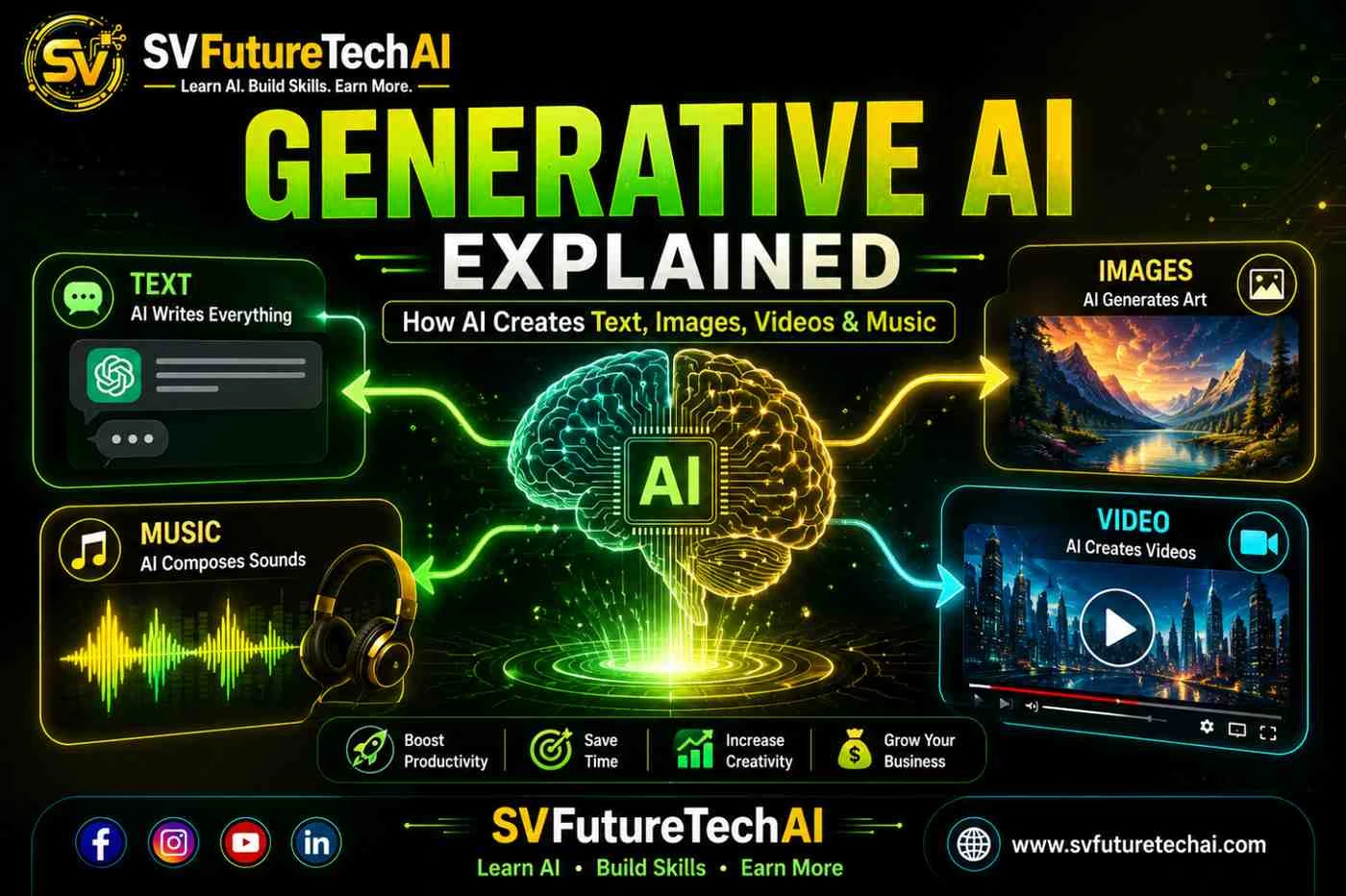
Artificial Intelligence has rapidly evolved from a futuristic concept into a technology that millions of people use every day. One of the most exciting developments in recent years is Generative AI. Unlike traditional software that follows predefined instructions, Generative AI can create entirely new content based on patterns learned from large amounts of data. It can write articles, generate images, compose music, create videos, design graphics, assist with programming, and even engage in natural conversations with users.
Many people interact with Generative AI without realizing the technology behind it. Popular tools such as ChatGPT, Gemini, Claude, Midjourney, DALL·E, Stable Diffusion, Suno AI, and various AI video generators are examples of Generative AI systems. These tools are transforming industries ranging from education and marketing to software development, healthcare, entertainment, and customer service.
At its core, Generative AI learns from massive collections of information. Instead of memorizing exact answers, it identifies relationships, patterns, structures, and probabilities within the data. When a user enters a prompt, the AI predicts and generates content that best matches the request. This process allows AI systems to produce text, images, audio, and videos that often appear remarkably human-like.
One of the most popular applications of Generative AI is text generation. Tools like ChatGPT can assist with writing blog posts, emails, product descriptions, reports, educational content, social media posts, and programming code. Students use AI for learning support, businesses use it for productivity, and developers use it to accelerate software creation.
Image generation is another rapidly growing area. AI image generators can transform simple text descriptions into detailed digital artwork, illustrations, logos, concept designs, marketing graphics, and realistic visual scenes. Designers often use these tools to accelerate creative workflows and explore new ideas.
Generative AI is also making an impact in video production. Modern AI tools can generate avatars, voiceovers, subtitles, animations, presentations, and promotional videos. These capabilities help content creators produce professional-quality media with less time and effort than traditional methods.
Music and audio generation have become increasingly popular as well. AI can compose original background music, create sound effects, generate voice narration, and assist musicians during the creative process. While AI does not replace human creativity, it serves as a powerful assistant that expands creative possibilities.
Despite its advantages, Generative AI has limitations. AI-generated content can occasionally contain inaccuracies, misunderstand context, or produce misleading information. Human review remains essential, especially in professional, legal, financial, and healthcare environments. Responsible use of AI requires fact-checking, ethical considerations, and transparency.
The future of Generative AI is expected to bring even more advanced capabilities. Businesses are investing heavily in AI-powered assistants, automation systems, personalized customer experiences, intelligent software, and creative tools. As these technologies become more accessible, understanding Generative AI will become an important digital skill for students, professionals, freelancers, entrepreneurs, and lifelong learners.
At SV Future Tech AI, we publish educational content about Artificial Intelligence, AI tools, programming, freelancing, automation, emerging technologies, and digital business opportunities. This article was created with the assistance of AI technology and carefully refined to provide practical, easy-to-understand information for readers. Our mission is to help people learn modern technology, build valuable skills, and stay prepared for the future of AI-driven innovation.