
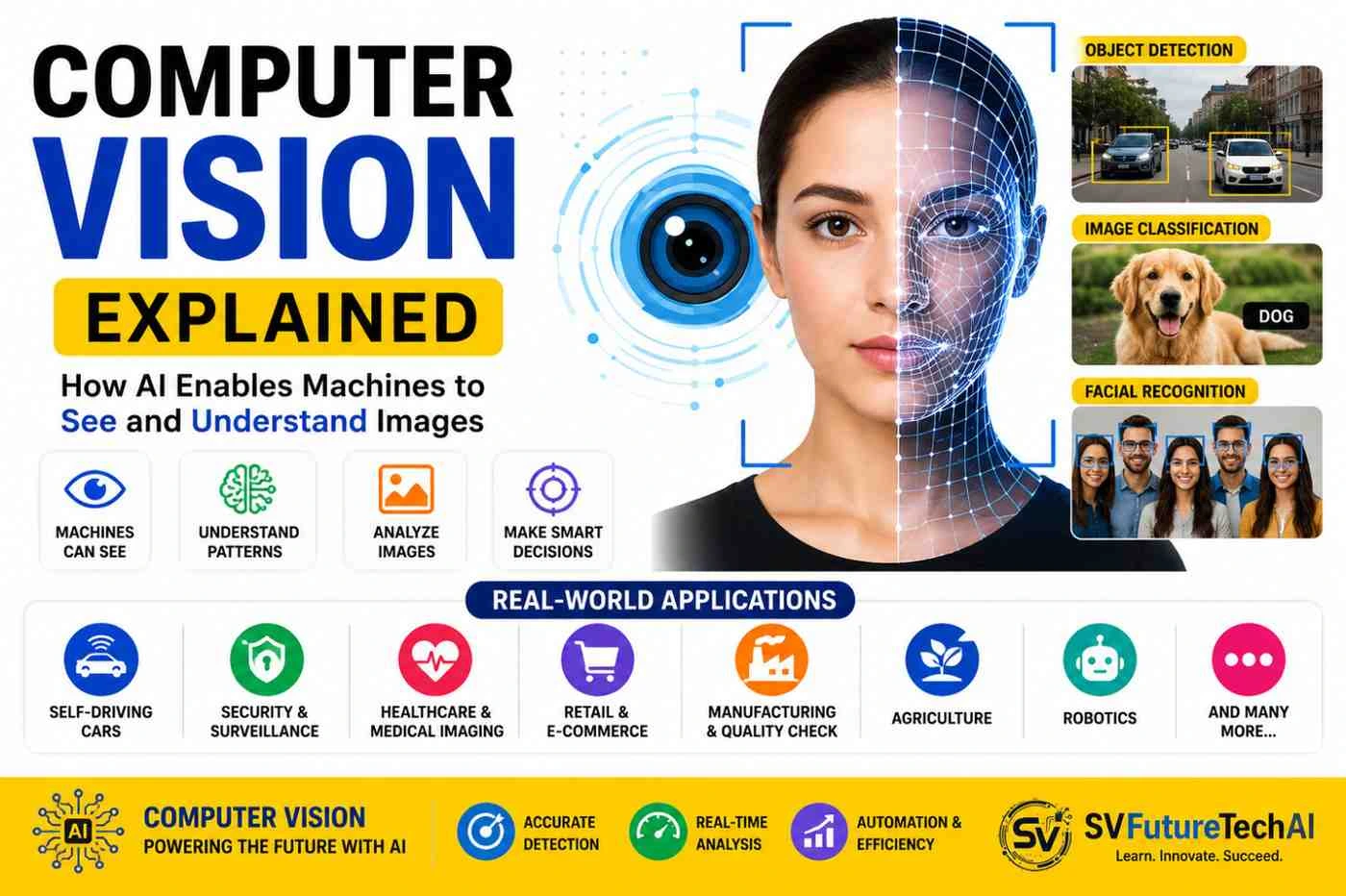
Human beings can instantly recognize faces, identify objects, read signs, and understand what is happening around them simply by looking at the world. For computers, however, interpreting visual information is far more challenging. A machine only sees pixels, colors, and numerical values. The field of Artificial Intelligence that helps computers analyze and understand visual information is known as Computer Vision.
Computer Vision is one of the most important branches of Artificial Intelligence. It focuses on enabling machines to process images, videos, and visual data in a way that resembles human perception. Over the last decade, advancements in Machine Learning and Deep Learning have significantly improved the capabilities of computer vision systems, allowing them to perform tasks that once seemed impossible.
Today, Computer Vision powers many technologies that people use daily. From unlocking smartphones using facial recognition to detecting diseases in medical scans and enabling autonomous vehicles to recognize road signs, this technology is becoming a fundamental part of modern life.
What is Computer Vision?
Computer Vision is an area of Artificial Intelligence that allows machines to capture, process, analyze, and interpret visual information from images and videos. Instead of simply storing pictures, AI systems can identify objects, recognize patterns, detect movements, and make decisions based on visual inputs.
For example, when you upload a photo to a social media platform and it automatically suggests tags for people in the image, Computer Vision is working behind the scenes.
How Computer Vision Works
A typical computer vision system follows several steps:
Image Acquisition
The system collects visual information through cameras, smartphones, drones, scanners, or video devices.
Image Processing
The image is cleaned and enhanced to improve quality and remove unnecessary noise.
Feature Extraction
The AI identifies important patterns such as shapes, colors, edges, textures, and object boundaries.
Analysis and Recognition
Machine learning models compare patterns and determine what objects or activities appear in the image.
Decision Making
The system uses the identified information to generate actions, recommendations, or automated responses.
Popular Computer Vision Applications
Facial Recognition
Used in smartphones, security systems, airports, and attendance management systems.
Self-Driving Vehicles
Autonomous cars use cameras and sensors to identify roads, traffic signs, pedestrians, and obstacles.
Healthcare and Medical Imaging
Doctors use AI-powered image analysis to assist with detecting abnormalities in X-rays, MRI scans, and medical images.
Retail and E-Commerce
Computer Vision helps analyze customer behavior, automate inventory management, and improve shopping experiences.
Manufacturing
Factories use visual inspection systems to identify defective products and maintain quality standards.
Agriculture
Farmers can monitor crop health, detect plant diseases, and optimize harvesting using AI-powered visual systems.
Security and Surveillance
Advanced monitoring systems can detect suspicious activities and improve public safety.
Technologies Behind Computer Vision
Several technologies contribute to modern Computer Vision systems:
Machine Learning
Helps systems learn from labeled visual data.
Deep Learning
Uses neural networks to recognize complex patterns in images.
Convolutional Neural Networks (CNNs)
Specialized neural networks designed for image recognition tasks.
Object Detection Models
Examples include:
- YOLO
- SSD
- Faster R-CNN
Image Segmentation
Helps AI understand different regions within an image.
Popular Computer Vision Tools and Platforms
OpenCV
One of the most widely used open-source computer vision libraries.
TensorFlow
Used for developing AI and computer vision applications.
PyTorch
Popular among researchers and AI developers.
Google Vision AI
Provides cloud-based image analysis services.
Amazon Rekognition
Offers facial analysis and object detection capabilities.
Azure Computer Vision
Microsoft's AI-powered vision platform.
Challenges of Computer Vision
Despite significant progress, Computer Vision still faces challenges:
- Poor image quality
- Low lighting conditions
- Occluded objects
- Complex environments
- Data privacy concerns
- Bias in training datasets
Researchers continue to improve models to make visual AI systems more accurate and reliable.
Why Computer Vision Matters
Computer Vision is transforming industries by enabling machines to interpret visual information at scale. Businesses can automate inspections, improve customer experiences, enhance security, and gain valuable insights from visual data.
As AI technology advances, Computer Vision is expected to play an even larger role in healthcare, transportation, manufacturing, robotics, education, agriculture, and smart cities. Understanding this technology provides valuable insight into how modern AI systems perceive and interact with the world around them.
SV Future Tech AI regularly publishes educational content about Artificial Intelligence, Machine Learning, Deep Learning, AI Tools, Programming, Automation, and emerging technologies. This article was prepared with the assistance of AI technology and carefully reviewed to provide practical, easy-to-understand information. Our mission is to help students, professionals, creators, and technology enthusiasts build future-ready skills and stay informed about the rapidly evolving world of Artificial Intelligence.