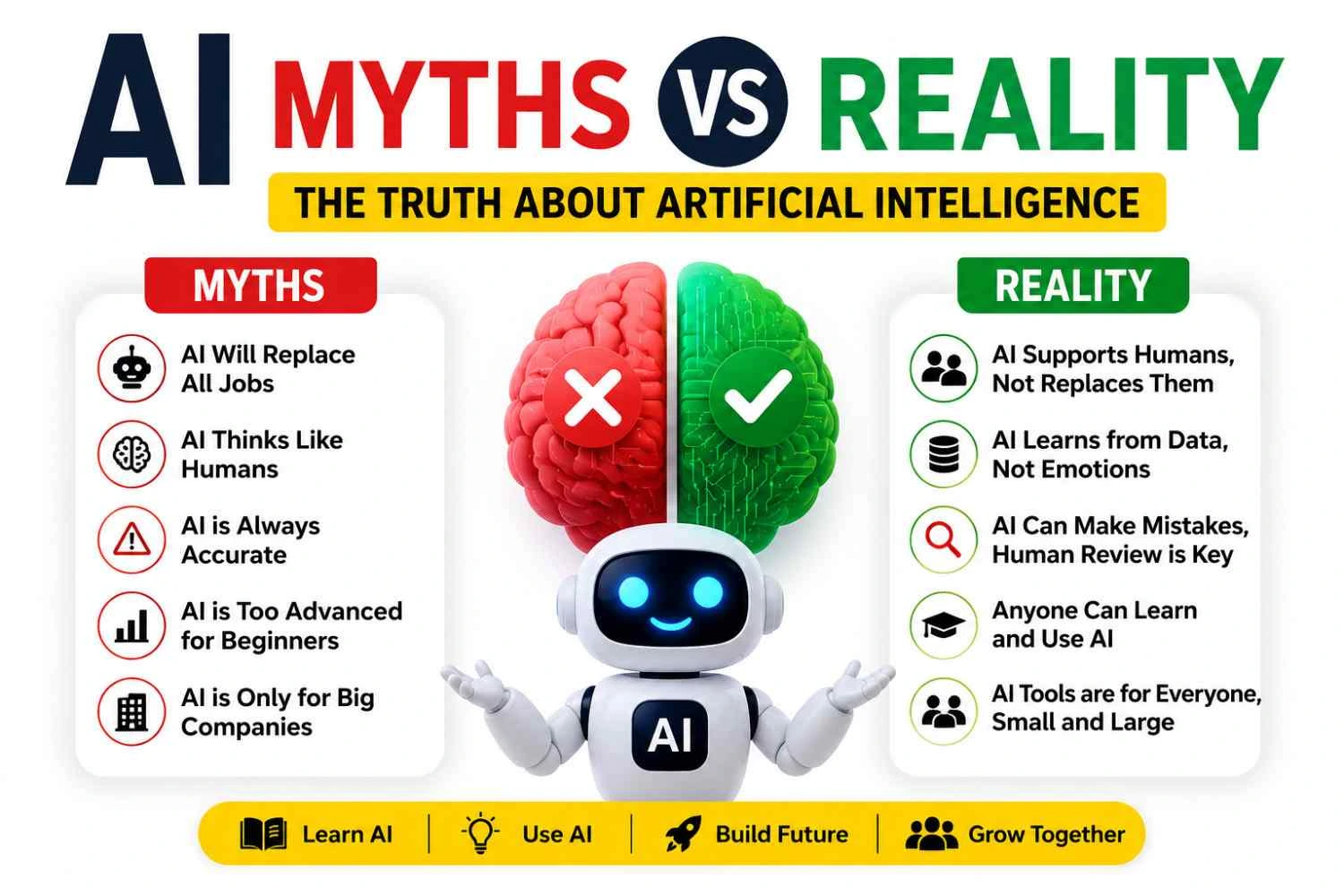
Over the last few years, Artificial Intelligence has moved from research laboratories into everyday life, becoming a technology that millions of people interact with through work, education, and digital services.News headlines, social media posts, movies, and online videos often present AI as something magical, dangerous, or capable of replacing every human job overnight. While AI has made remarkable progress, many popular beliefs about it are either exaggerated or completely incorrect.
These misconceptions can create unnecessary fear or unrealistic expectations. Some people believe AI can think exactly like humans, while others assume it is always accurate or that only programmers can use it. The truth is much more balanced.
Understanding what AI can and cannot do is important for students, professionals, business owners, freelancers, and anyone planning to work with modern technology. Knowing the facts helps people make better decisions, learn new skills, and use AI responsibly.
This guide explains some of the most common myths surrounding Artificial Intelligence and compares them with the real-world facts.
Top AI Myths vs Reality
Myth 1: AI Will Replace Every Human Job
Reality
One of AI's primary strengths is handling routine processes and analyzing large volumes of information, allowing people to spend more time on creative thinking and decision-making.While some roles will change, many new careers are emerging in AI development, prompt engineering, AI consulting, automation, cybersecurity, data science, AI content review, and robotics. In most industries, AI works best as a productivity assistant rather than a complete replacement for people.
Myth 2: AI Thinks Like Humans
Reality
Current AI systems do not possess human consciousness, emotions, or independent understanding. They identify patterns in data and generate responses based on training, but they do not "think" or "feel" in the same way humans do.
Myth 3: AI Is Always Correct
Reality
AI can produce inaccurate information, outdated facts, or fabricated responses. Users should verify important information, especially in medical, legal, financial, or scientific contexts.
Myth 4: AI Will Become Self-Aware Soon
Reality
Today's AI models are advanced prediction systems. They do not have self-awareness, personal goals, or consciousness.
Myth 5: Only Programmers Can Use AI
Reality
Modern AI tools are designed for everyone. Students, teachers, writers, marketers, designers, entrepreneurs, and business owners can benefit from AI without writing code.
Myth 6: AI Creates Everything Automatically
Reality
High-quality AI results usually require clear instructions, human review, editing, and fact-checking. AI speeds up work, but human expertise remains essential.
Myth 7: AI Will Eliminate Creativity
Reality
Many creators use AI as a brainstorming and productivity tool. Human imagination, storytelling, design judgment, and originality continue to play a critical role.
Myth 8: AI Can Learn Anything Instantly
Reality
AI systems depend on training data, model design, and updates. They do not automatically learn from every new interaction.
Myth 9: AI Knows Everything
Reality
AI has limitations. It may not know recent events unless updated and can misunderstand context or complex questions.
Myth 10: AI Is Only for Large Companies
Reality
Affordable AI tools are available for freelancers, students, startups, educators, and small businesses. Many powerful AI services even offer free plans.
Myth 11: AI Can Replace Teachers
Reality
AI can explain concepts and provide learning support, but teachers contribute mentorship, critical thinking, classroom interaction, and emotional guidance that AI cannot replicate.
Myth 12: AI Is Dangerous by Default
Reality
AI itself is a tool. The benefits and risks depend on how humans design, regulate, and use it responsibly.
Myth 13: AI Is Too Expensive
Reality
Many excellent AI tools provide generous free versions suitable for learning, productivity, and content creation.
Myth 14: AI Works Without Data
Reality
Data is the foundation of AI. Without quality data, AI models cannot produce reliable results.
Myth 15: AI Will Stop Evolving
Reality
Artificial Intelligence continues to improve rapidly, with new models, tools, and applications appearing every year.
Popular AI Tools
AI Chatbots
- ChatGPT
- Claude
- Gemini
- Microsoft Copilot
- Perplexity AI
AI Writing
- Grammarly
- QuillBot
- Jasper AI
- Copy.ai
AI Image Generation
- ChatGPT Images
- Midjourney
- Leonardo AI
- Adobe Firefly
- Canva AI
AI Coding
- GitHub Copilot
- Cursor AI
- Codeium
- Windsurf
AI Video
- Runway
- Pika
- Synthesia
- HeyGen
Final Thoughts
Artificial Intelligence is transforming industries, but understanding it requires separating facts from misconceptions. Rather than fearing AI or expecting it to solve every problem, it is more helpful to view it as a powerful tool that can improve productivity, creativity, and decision-making when used responsibly.
As AI technology evolves, developing AI literacy will become an essential skill for students, professionals, freelancers, and business owners. Learning what AI can realistically achieve—and where its limitations lie—helps individuals make informed decisions and prepare for future opportunities.
At SV Future Tech AI, our goal is to simplify modern technology through well-researched articles covering Artificial Intelligence, productivity tools, software development, automation, freelancing opportunities, online business ideas, and future technology trends. Every article is written to help readers gain practical knowledge they can apply in real life. This article was prepared with the assistance of AI technology and carefully reviewed to provide accurate, reader-friendly information. Our mission is to help learners, professionals, creators, and entrepreneurs understand modern technology, build future-ready skills, and confidently navigate the rapidly evolving AI landscape.