Artificial Intelligence is evolving far beyond simple chatbots and content generators. One of the most exciting developments in the AI industry is the rise of AI Agents. While many people are familiar with AI tools such as ChatGPT, Gemini, Claude, and Microsoft Copilot, fewer people understand the concept of AI Agents and why they are becoming one of the most important trends in modern technology.
An AI Agent is an intelligent software system designed to perform tasks, make decisions, and take actions with minimal human intervention. Unlike traditional software that follows fixed instructions, AI Agents can observe their environment, understand goals, plan actions, execute tasks, and adapt based on feedback. In simple terms, an AI Agent acts more like a digital assistant that can independently work toward completing an objective rather than simply answering questions.
Imagine asking an AI system to book a meeting, gather information from multiple websites, prepare a report, send emails, and notify team members once everything is completed. A traditional chatbot may provide guidance, but an AI Agent can potentially perform the entire workflow automatically. This ability to take action is what makes AI Agents different from conventional AI applications.
Modern AI Agents typically combine several technologies including Large Language Models (LLMs), memory systems, reasoning frameworks, planning mechanisms, APIs, automation tools, and external data sources. These components work together to help the agent understand complex requests and perform multi-step tasks. The result is a system that can operate more independently and provide greater value in real-world scenarios.
Key Components of AI Agents
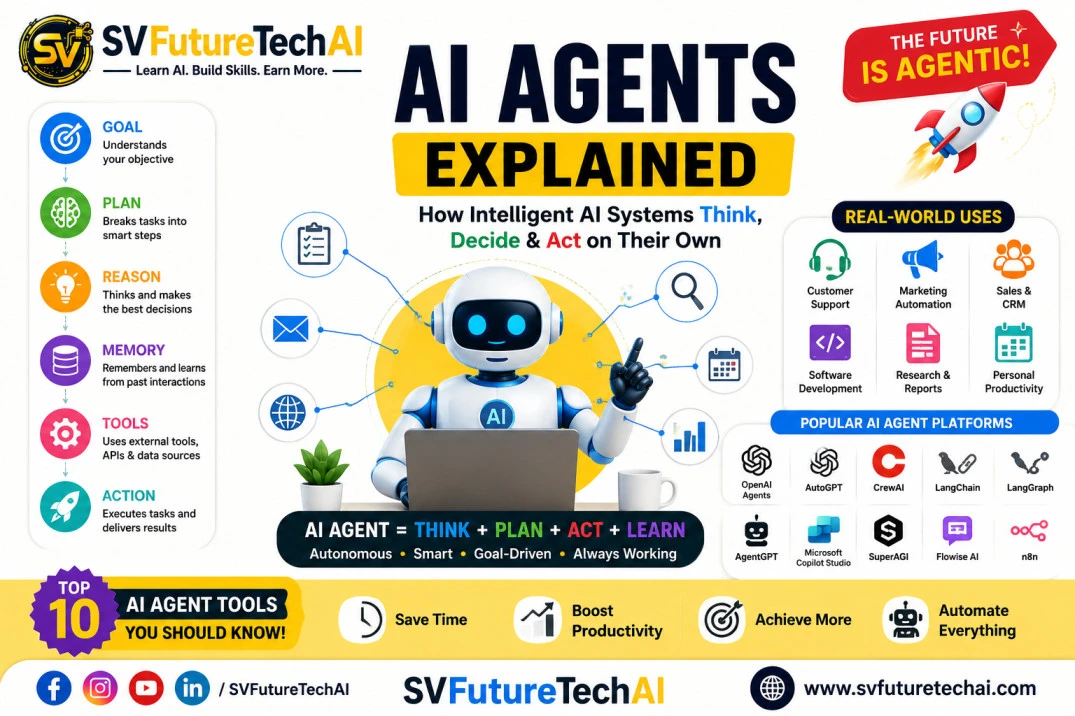
1. Goal Understanding
AI Agents begin by understanding the objective provided by the user.
2. Planning
The system breaks large tasks into smaller manageable steps.
3. Reasoning
The agent evaluates available information and determines the best course of action.
4. Memory
Some AI Agents remember previous interactions and use that context to improve future decisions.
5. Tool Usage
Agents can connect with external applications, databases, APIs, search engines, and automation platforms.
6. Execution
The agent performs actions based on the plan it has created.
Popular AI Agent Platforms
AI Agent Tools and Frameworks
- OpenAI Agents
- AutoGPT
- CrewAI
- LangGraph
- LangChain
- Microsoft Copilot Studio
- AgentGPT
- SuperAGI
- Flowise AI
- n8n AI Agents
Real-World Uses of AI Agents
Business Operations
- Customer support automation
- Lead management
- Sales assistance
- CRM updates
Marketing
- Content creation
- Social media scheduling
- Campaign management
- Email automation
Development
- Code generation
- Bug detection
- Documentation creation
- Testing automation
Personal Productivity
- Calendar management
- Research assistance
- Meeting preparation
- Task tracking
One of the reasons AI Agents are attracting so much attention is their ability to automate repetitive tasks. Businesses spend thousands of hours every year performing manual processes that can potentially be handled by intelligent systems. AI Agents can reduce workload, improve efficiency, and allow teams to focus on higher-value activities.
However, AI Agents are not perfect. They may occasionally misunderstand instructions, rely on incomplete information, or perform actions that require human review. Security, privacy, transparency, and ethical considerations remain important factors when deploying autonomous systems. Organizations must carefully evaluate where AI Agents can safely operate and where human oversight remains necessary.
The next generation of AI Agents is likely to handle more complex responsibilities, helping individuals and businesses automate tasks that currently require significant human effort.Future agents may collaborate with one another, manage complex workflows, perform advanced research, interact with multiple software platforms, and support decision-making across industries. Many experts believe that Agentic AI could become one of the most transformative technologies of the coming decade.
Understanding AI Agents today helps individuals and businesses prepare for a future where intelligent digital assistants become a common part of everyday work and life.
SV Future Tech AI regularly publishes educational content about Artificial Intelligence, AI tools, automation, programming, freelancing, emerging technologies, and digital innovation. This article was created with the assistance of AI technology and carefully reviewed to provide readers with practical, easy-to-understand information. Our mission is to help students, professionals, entrepreneurs, and technology enthusiasts understand the rapidly changing world of AI and develop skills that remain valuable in the future.