Artificial Intelligence has become one of the most discussed technologies in the modern world. From ChatGPT and self-driving cars to recommendation systems on Netflix and personalized shopping suggestions on e-commerce websites, AI is influencing our daily lives more than ever before. However, many people often get confused when they hear terms like Artificial Intelligence (AI), Machine Learning (ML), and Deep Learning (DL). While these terms are related, they are not the same. Understanding their differences can help students, developers, business owners, and technology enthusiasts better understand how modern intelligent systems work.
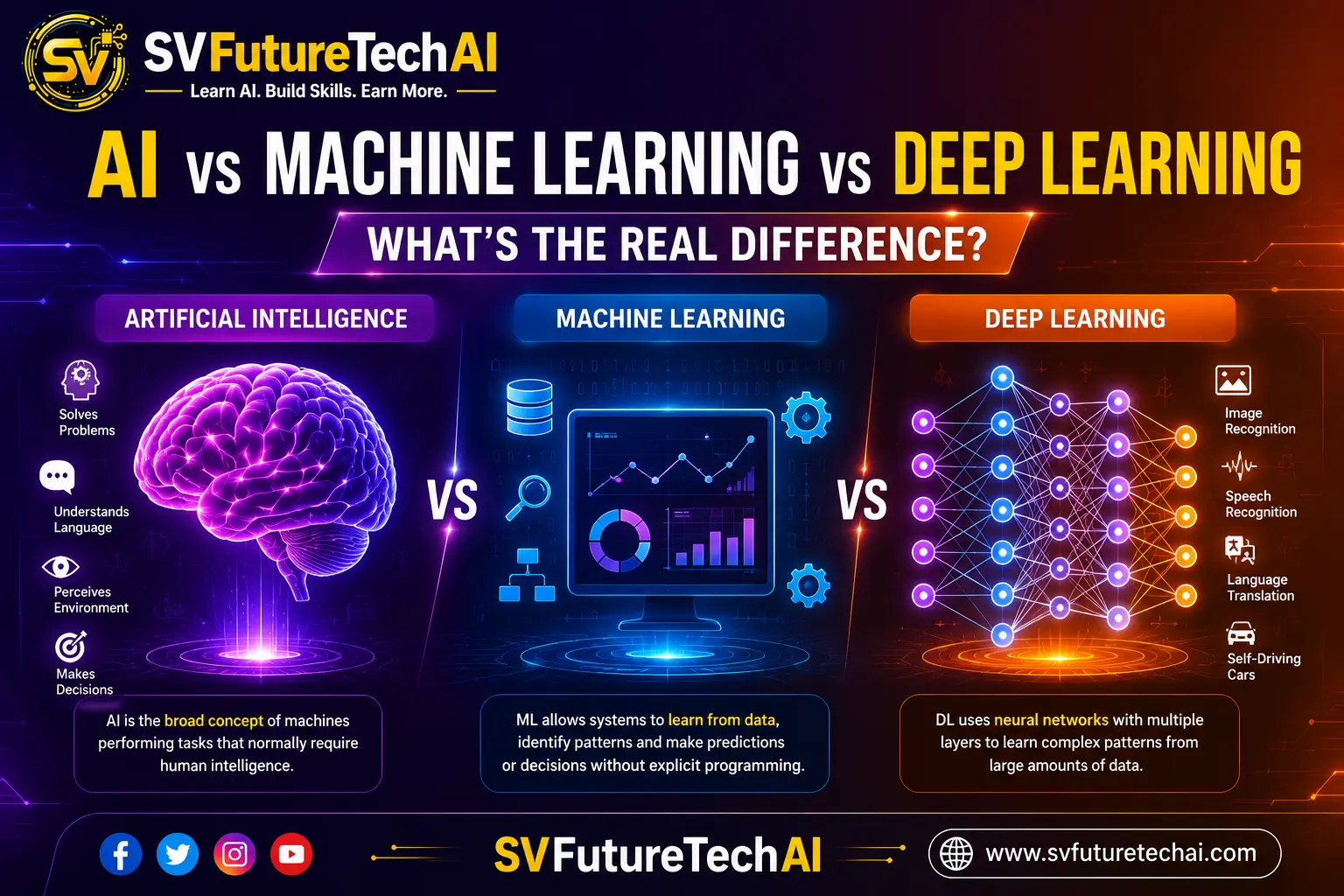
Artificial Intelligence, commonly known as AI, is the broadest concept among the three. Think of Artificial Intelligence as teaching computers to handle situations that usually need human thinking. Instead of following fixed instructions for every scenario, AI-powered systems can analyze information, recognize patterns, and respond in ways that appear intelligent to users. These tasks may include learning, problem-solving, decision-making, language understanding, image recognition, and pattern analysis. The primary goal of AI is to create systems that can simulate human intelligence and assist people in solving real-world problems. Virtual assistants, recommendation engines, fraud detection systems, and intelligent chatbots are all examples of AI applications.
Machine Learning is a subset of Artificial Intelligence. Instead of explicitly programming a machine for every task, Machine Learning enables computers to learn from data and improve their performance over time. Machine Learning works by studying examples from the past and discovering hidden relationships within data. Once these relationships are understood, the system can estimate outcomes, suggest actions, or recognize trends without being manually programmed for every possibility. For example, an email spam filter learns to identify unwanted emails by analyzing thousands of previous examples. Similarly, recommendation systems used by streaming platforms learn user preferences and suggest relevant content based on past behavior.
Deep Learning is a specialized branch of Machine Learning that uses Artificial Neural Networks inspired by the structure of the human brain. Unlike traditional Machine Learning methods, Deep Learning models can automatically identify complex patterns from large amounts of data without extensive human intervention. This capability has enabled significant advancements in image recognition, speech processing, language translation, autonomous vehicles, and generative AI tools such as ChatGPT and image-generation platforms.
One simple way to understand the relationship is to imagine three concentric circles. The largest circle represents Artificial Intelligence. Inside AI lies Machine Learning, and within Machine Learning exists Deep Learning. In other words, every Deep Learning system is a Machine Learning system, and every Machine Learning system belongs to the broader field of Artificial Intelligence.
When comparing these technologies, AI focuses on creating intelligent behavior, Machine Learning focuses on learning from data, and Deep Learning focuses on solving complex problems using multi-layer neural networks. Machine Learning generally requires structured data and feature engineering, while Deep Learning can process large volumes of unstructured data such as images, videos, and natural language. Deep Learning often requires greater computational power, specialized hardware, and larger datasets compared to traditional Machine Learning techniques.
The rapid growth of AI tools has made these technologies accessible to businesses of all sizes. Companies use AI to automate customer support, analyze business data, improve marketing campaigns, detect fraud, and optimize operations. Healthcare organizations leverage AI for disease prediction and medical imaging analysis. Educational platforms use AI-powered tutoring systems to provide personalized learning experiences. These real-world applications demonstrate how AI, Machine Learning, and Deep Learning are transforming industries across the globe.
As technology continues to evolve, understanding the differences between AI, Machine Learning, and Deep Learning becomes increasingly important. Whether you are planning a career in technology, developing AI-powered applications, or simply exploring the future of innovation, a solid understanding of these concepts provides a strong foundation for learning and growth.
SV Future Tech AI regularly publishes educational articles, tutorials, industry updates, AI tool reviews, freelancing guides, and emerging technology insights. This article has been created with the assistance of AI technology and carefully reviewed to ensure clarity, accuracy, and practical value for readers. Our mission is to make Artificial Intelligence and modern technology accessible to students, professionals, freelancers, entrepreneurs, and anyone interested in understanding the technologies shaping the future.