Have you ever wondered how ChatGPT can answer questions, write stories, generate code, or even help with homework? It may feel like magic, but behind the scenes, a powerful technology called a Large Language Model (LLM) is doing the work.
LLMs are one of the biggest breakthroughs in Artificial Intelligence. They have transformed how humans interact with computers by allowing machines to understand and generate human-like language.
In this article, we'll break down how LLMs work in simple terms, without requiring a computer science degree. Whether you're a student, developer, business owner, or simply curious about AI, this guide will help you understand the technology powering today's smartest AI tools.
Imagine teaching a child to communicate by giving them millions of books, articles, conversations, and examples of written language. Over time, the child begins to recognize patterns, understand context, and predict what words should come next in a sentence. Large Language Models learn in a similar way.
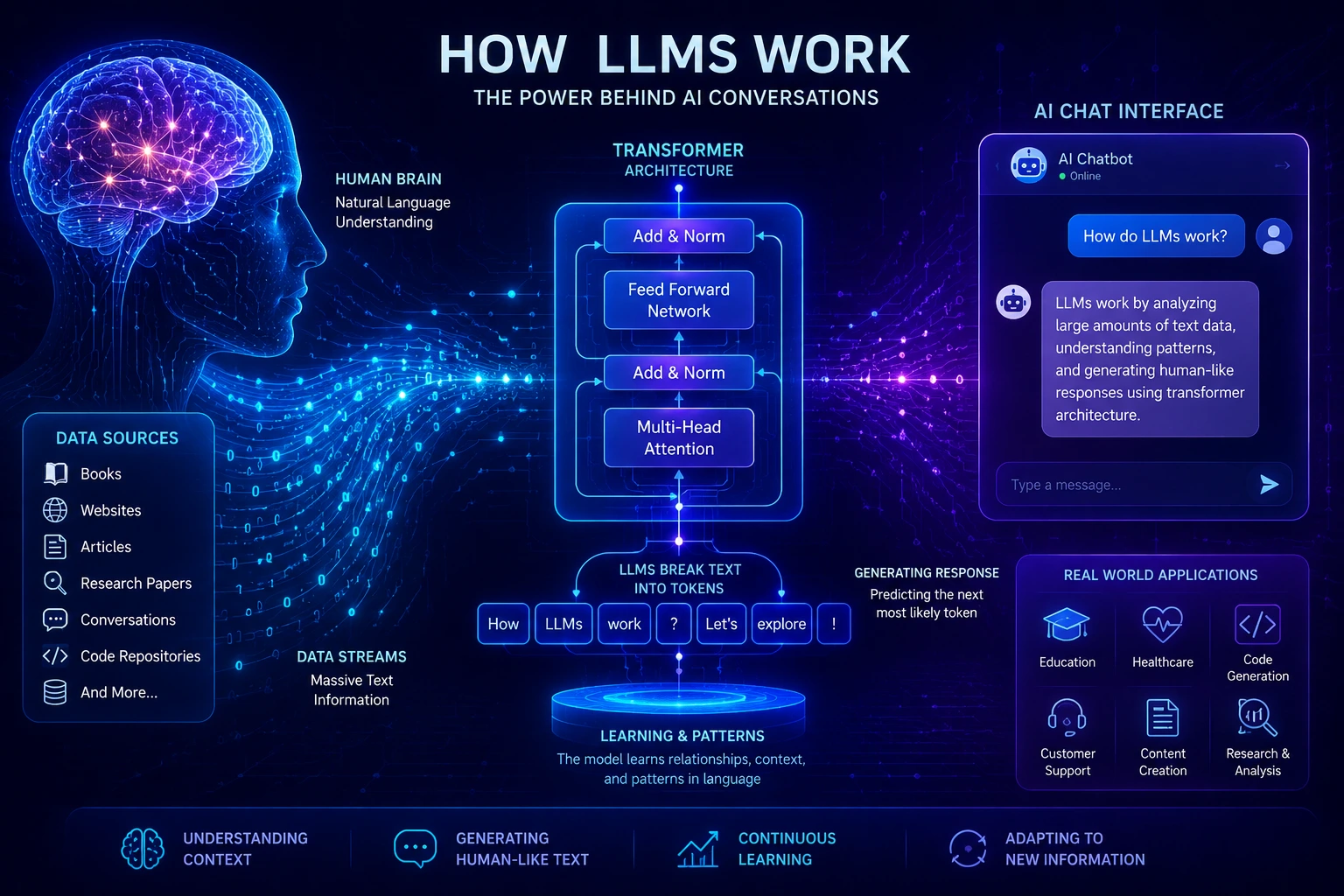
An LLM is a deep learning model trained on massive amounts of text data collected from books, websites, articles, research papers, and many other sources. During training, the model doesn't memorize exact answers. Instead, it learns relationships between words, phrases, and ideas.
The basic unit an LLM works with is called a token.Every time you interact with an AI tool like ChatGPT, your message is broken down into smaller units known as tokens. These tokens may include words, fragments of words, or punctuation symbols. The AI processes these tokens to understand the context of your query and generate accurate, relevant responses.
The real breakthrough behind modern LLMs is the Transformer architecture. Introduced by researchers in 2017, transformers allow AI models to pay attention to different parts of a sentence simultaneously. This helps the model understand context much better than older AI systems.
For example, in the sentence:
"Rakesh deposited money in the bank before going fishing near the river bank."
A transformer can understand that the first "bank" refers to a financial institution while the second refers to the side of a river.
Once trained, an LLM generates responses by predicting the most likely next token based on the context provided. It repeats this process token by token until a complete answer is formed.
Models like ChatGPT, Claude, Gemini, and other AI assistants are built using this approach. The larger the model and the better the training data, the more capable it becomes at understanding language, reasoning, and generating useful responses.
However, LLMs are not perfect. They can sometimes provide incorrect information, misunderstand complex questions, or generate content that sounds convincing but isn't accurate. This is why human verification remains important when using AI-generated content.
As AI technology continues to evolve, LLMs are becoming more powerful and efficient. They are already transforming education, software development, customer support, content creation, healthcare, and countless other industries.
Understanding how LLMs work helps us use AI more effectively and prepares us for a future where intelligent systems become a regular part of everyday life.